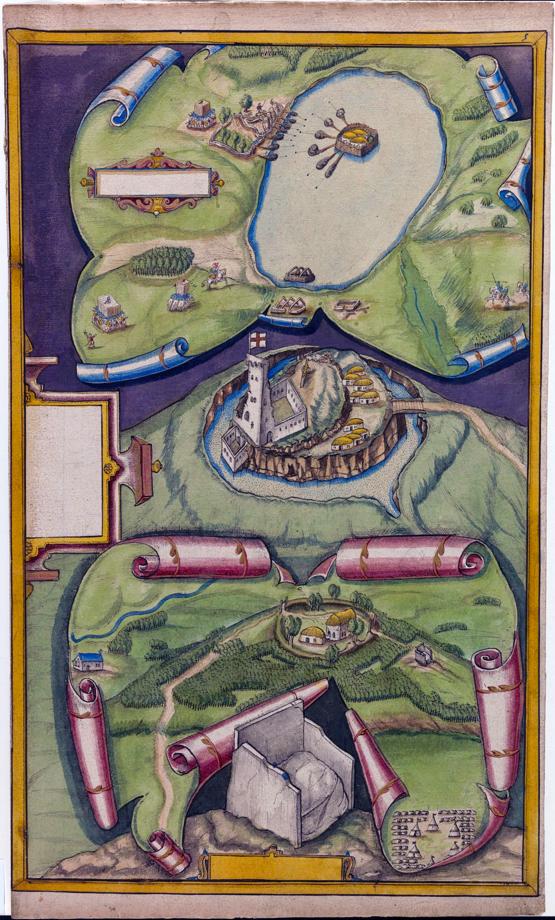
What could a stone chair tell us about Gaelic authority? Who could decide that a Galway family had to leave its home? Follow these questions from a drawing of Tullyhogue in 1602 to the letters and orders of the Commonwealth government.
In these papers, “transplantation” means compulsory relocation. “Adventurers” were investors who had advanced money in return for Irish land. A petition records what someone asked for. An order tells us what officials wanted done. Neither, on its own, tells us what happened to every family.
Each PDF opens on this site. The file label identifies the source format. Quotations from the settlement papers follow the words reproduced in Dunlop’s 1913 edition. Neighbouring entries and the editor’s notes are visible on the scanned pages.
“seven pounds of oatmeal or six pounds of biscuit”
In plain English
The instructions reckoned a soldier’s weekly allowance in food as well as money. A garrison on a map needed a regular flow of grain, bread and transport. These quantities give us a way to picture that demand on the surrounding country.
Robert Dunlop (ed.), Ireland under the Commonwealth, vol. II (Manchester University Press, 1913), record 293, quoted passage on printed p. 292. Source edition
“quitted their habitations and removed their stocks”
In plain English
Officials interpreted departure as disloyalty and complained that the tax burden fell on those who stayed. They ordered property to be taken into state hands. The departing households left no explanation of their motives in this order.
Robert Dunlop (ed.), Ireland under the Commonwealth, vol. II (Manchester University Press, 1913), record 355, quoted passage on printed p. 326. Source edition
The commission traced its authority to an earlier grant of powers. In Cork those powers allowed officials to set out land for disbanded soldiers. A piece of military pay paperwork could change who held a farm.
Robert Dunlop (ed.), Ireland under the Commonwealth, vol. II (Manchester University Press, 1913), record 448, quoted passage on printed p. 390. Source edition
Officials wanted the people allocating land to distinguish between the lands available for paying soldiers and those outside that fund. A surveyor’s classification could therefore determine whether an estate was even considered for a grant.
Robert Dunlop (ed.), Ireland under the Commonwealth, vol. II (Manchester University Press, 1913), record 484, quoted passage on printed p. 418. Source edition
Disbanded officers and soldiers put requests to the authorities about their back pay. Once land became the means of payment, what had begun as a claim for wages became a claim on a particular place.
Robert Dunlop (ed.), Ireland under the Commonwealth, vol. II (Manchester University Press, 1913), record 517, quoted passage on printed p. 434. Source edition
Joseph Avery petitioned on behalf of people holding written acknowledgments of public debt. The council had to consider how to satisfy them. These papers help explain why people far from a particular farm could still claim a financial interest in its future.
Robert Dunlop (ed.), Ireland under the Commonwealth, vol. II (Manchester University Press, 1913), record 575, quoted passage on printed p. 465. Source edition
“their proportion of lands in some other convenient place”
In plain English
The order considered proprietors whose land in Tirawley had been laid out for soldiers. Their shares were to be found elsewhere. One allocation could displace another family even after a district had been chosen for them.
Robert Dunlop (ed.), Ireland under the Commonwealth, vol. II (Manchester University Press, 1913), record 589, quoted passage on printed p. 472. Source edition
“according to the number of baronies set out to them”
In plain English
Commissioners had to send back books showing the division of land. The instructions work down from baronies through parishes to individual shares. This is how a district became a set of entries against particular soldiers’ names.
Robert Dunlop (ed.), Ireland under the Commonwealth, vol. II (Manchester University Press, 1913), record 603, quoted passage on printed p. 479. Source edition
Some families took provisional land from the commissioners at Loughrea to maintain their livestock. This order relieved them of rent while still requiring a share of the public levy. Rent and tax remained separate demands.
Robert Dunlop (ed.), Ireland under the Commonwealth, vol. II (Manchester University Press, 1913), record 649, quoted passage on printed p. 498. Source edition
Ardee appears in a list with places in Fermanagh, Connacht and Munster. The administration grouped distant areas together to meet claims for land. Reading the place names restores some geography to a document written in the language of debt.
Robert Dunlop (ed.), Ireland under the Commonwealth, vol. II (Manchester University Press, 1913), record 671, quoted passage on printed p. 507. Source edition
The administration doubted that enough confiscated land was available for the full bill. It kept to an arrangement based on two-thirds of arrears. Land promised to soldiers still had to be found somewhere.
Robert Dunlop (ed.), Ireland under the Commonwealth, vol. II (Manchester University Press, 1913), record 705, quoted passage on printed p. 530. Source edition
“the setting out of lands to the disbanded officers and soldiers”
In plain English
Thomas Herbert wrote to the officials dividing land in Cork, expecting work to have advanced under earlier instructions. The letter catches settlement between two stages: a decision made at the centre and the labour of marking out shares on the ground.
Robert Dunlop (ed.), Ireland under the Commonwealth, vol. II (Manchester University Press, 1913), record 730, quoted passage on printed p. 541. Source edition
The council feared that an increased levy would persuade London that Ireland could afford a cut in military support. Read the plea alongside the sum assessed. Money demanded on paper was not necessarily money collected.
Robert Dunlop (ed.), Ireland under the Commonwealth, vol. II (Manchester University Press, 1913), record 865, quoted passage on printed p. 617. Source edition
Account commissioners found names on lists that seemed ineligible under the army’s payment rules. Before a paper claim could be exchanged, someone checked the claimant against an Act of Parliament.
Robert Dunlop (ed.), Ireland under the Commonwealth, vol. II (Manchester University Press, 1913), record 900, quoted passage on printed p. 634. Source edition
The council told the Protector that Wicklow land promised to Liverpool had already been committed to another settlement of arrears. Compare the promise with this reply. Two creditors could be offered an interest in the same limited supply of land.
Robert Dunlop (ed.), Ireland under the Commonwealth, vol. II (Manchester University Press, 1913), record 958, quoted passage on printed p. 675. Source edition
Broghill and the other officials received authority to take up ships for transporting men from Muskerry’s forces. A military agreement reached inland could put demands on merchants, crews and vessels along the coast.
Robert Dunlop (ed.), Ireland under the Commonwealth, vol. II (Manchester University Press, 1913), record 322, quoted passage on printed p. 308. Source edition
“without pressing of any who shall not go willingly”
In plain English
Ingoldsby wanted to transport 1,500 people. The commissioners made consent a condition in their reply. To know what choice any particular person had, we would need to hear from those approached as well as from the men arranging the voyage.
Robert Dunlop (ed.), Ireland under the Commonwealth, vol. II (Manchester University Press, 1913), record 324, quoted passage on printed p. 309. Source edition
Officials told London about troops sent by sea and others marching through western Connacht. Their estimate of provisions shows how dependent the expedition was on boats, food and time.
Robert Dunlop (ed.), Ireland under the Commonwealth, vol. II (Manchester University Press, 1913), record 329, quoted passage on printed p. 310. Source edition
The commissioners understood the surrender agreement to require transport for a thousand men within three weeks. A promise made to secure a surrender left an immediate practical question: where were sufficient ships to come from?
Robert Dunlop (ed.), Ireland under the Commonwealth, vol. II (Manchester University Press, 1913), record 347, quoted passage on printed p. 319. Source edition
“to bring down to the sea coast very great numbers of men”
In plain English
Irish officers had made agreements to bring men to the coast. The commissioners described the growing pressure to move them abroad. Bringing people to a port and securing a ship for them were separate undertakings.
Robert Dunlop (ed.), Ireland under the Commonwealth, vol. II (Manchester University Press, 1913), record 360, quoted passage on printed p. 328. Source edition
The commissioners claimed that both ships and provisions were available in Galway. By undertakers they meant people prepared to take responsibility for the venture. The account treats the people facing removal largely as a matter of cost and arrangements.
Robert Dunlop (ed.), Ireland under the Commonwealth, vol. II (Manchester University Press, 1913), record 382, quoted passage on printed p. 341. Source edition
Writing to Colonel Phaire, the commissioners described a four-year term and a payment connected with embarkation. These were the terms presented by the organisers. The letter cannot show whether the terms were honoured after arrival.
Robert Dunlop (ed.), Ireland under the Commonwealth, vol. II (Manchester University Press, 1913), record 507, quoted passage on printed p. 430. Source edition
Phaire’s figures reached the commissioners as numbers assigned to different officers. The reply considered sending four hundred people to the Caribbean. Its language tells us how much control the commissioners believed they had over the people waiting.
Robert Dunlop (ed.), Ireland under the Commonwealth, vol. II (Manchester University Press, 1913), record 513, quoted passage on printed p. 433. Source edition
Muskerry’s negotiations over a foreign destination
Commonwealth papers · 1654
Original words
“into any foreign parts in amity with the Commonwealth”
In plain English
The council recalled terms allowing Muskerry to take men abroad and reported talks about Flanders. The phrase about amity placed an important restriction on their destination: the receiving power had to be on friendly terms with the Commonwealth.
Robert Dunlop (ed.), Ireland under the Commonwealth, vol. II (Manchester University Press, 1913), record 544, quoted passage on printed p. 452. Source edition
Who carried the cost of sending soldiers to Spain?
Commonwealth papers · 1655
Original words
“the accounts of the said gentlemen to be examined on oath”
In plain English
Officers claimed a loss when arrangements with Spain failed to pay as expected. The council described checking their accounts under oath. We can trace who sought reimbursement more easily here than what became of the soldiers.
Robert Dunlop (ed.), Ireland under the Commonwealth, vol. II (Manchester University Press, 1913), record 669, quoted passage on printed p. 506. Source edition
The declaration looked back on deadlines requiring whole households to move to Connacht or Clare. Naming the family makes visible what a rule apparently addressed to a landholder meant for dependants.
Robert Dunlop (ed.), Ireland under the Commonwealth, vol. II (Manchester University Press, 1913), record 870, quoted passage on printed p. 619. Source edition
Manuscript drawing with a companion written account
Why did a stone chair matter at Tullyhogue?
Richard Bartlett, 1602 · words from Fynes Moryson’s account
Original words
“being of Stone, planted in the open field”
In plain English
Look at the bottom of Richard Bartlett’s drawing. The stone seat is shown large enough to study. It was used in the inauguration of the O’Neills. The words beside it here come from Fynes Moryson’s account of Mountjoy breaking the chair in 1602. Read together, the drawing and the account show what an attack on Gaelic political authority could mean in one particular place.
Richard Bartlett, Dungannon and Tullyhogue, 1602. Public-domain image via Wikimedia Commons. Quotation from Fynes Moryson as cited in the notes to A Treatise of Ireland, CELT, University College Cork. Source edition
The commissioners answered a question about friars already in custody by referring local officers to a declaration. The short phrase establishes that they were being held. It gives us none of the friars’ own account of the arrest.
Robert Dunlop (ed.), Ireland under the Commonwealth, vol. II (Manchester University Press, 1913), record 328, quoted passage on printed p. 309. Source edition
How officials read Irish hopes of help from abroad
Commonwealth papers · 1653
Original words
“hopes of succour from Lorraine”
In plain English
Writing to Hardress Waller, the commissioners imagined what Irish opponents hoped for and what God would allow. This is valuable evidence of an official outlook. The people whose hopes they describe had no part in writing the letter.
Robert Dunlop (ed.), Ireland under the Commonwealth, vol. II (Manchester University Press, 1913), record 330, quoted passage on printed p. 311. Source edition
When a poor-relief officer could decide who sailed
Commonwealth papers · 1653
Original words
“such vagrants, idle, and incorrigible persons”
In plain English
A merchant sought a licence to transport Irish people to the Caribbean. The order gave poor-relief officials a role in selecting men and women. Those words are categories imposed by the officials. They cannot tell us a person’s trade, community or identity.
Robert Dunlop (ed.), Ireland under the Commonwealth, vol. II (Manchester University Press, 1913), record 381, quoted passage on printed p. 341. Source edition
“the Irish of that town were to be forthwith transplanted”
In plain English
A letter to Timolin’s governor pursued an earlier order after a killing in the town. Its stated consequence fell on the town’s Irish residents collectively. The council demanded to know why the governor had delayed carrying it out.
Robert Dunlop (ed.), Ireland under the Commonwealth, vol. II (Manchester University Press, 1913), record 620, quoted passage on printed p. 485. Source edition
“intended to be planted with English and Protestants”
In plain English
The preamble linked the compulsory movement of people with the security of areas reserved for settlement. The wording makes plain which inhabitants the government wanted in those places and whose presence it regarded as a risk.
Robert Dunlop (ed.), Ireland under the Commonwealth, vol. II (Manchester University Press, 1913), record 626, quoted passage on printed p. 488. Source edition
The authorities placed Sunday observance alongside drinking and swearing in a letter to judges. Their complaints show the religious standards they wanted enforced. They give us a much poorer guide to how people understood their own customs.
Robert Dunlop (ed.), Ireland under the Commonwealth, vol. II (Manchester University Press, 1913), record 642, quoted passage on printed p. 496. Source edition
Permission depended in part on how officials judged a tenant’s conduct during the rebellion. For a family seeking a tenancy, the landlord’s willingness to let land was only part of the question.
Robert Dunlop (ed.), Ireland under the Commonwealth, vol. II (Manchester University Press, 1913), record 681, quoted passage on printed p. 516. Source edition
“as he shall justly conceive to be disaffected or dangerous persons”
In plain English
An order tied the removal of residents to the governor’s own judgment. Its language of security gave a single official considerable say over whether someone could go on living in the city.
Robert Dunlop (ed.), Ireland under the Commonwealth, vol. II (Manchester University Press, 1913), record 871, quoted passage on printed p. 620. Source edition
The council reported a feared alliance with Spain and imagined support from within Ireland. Probable is the telling word. We are reading an assessment of danger that officials acted on, rather than testimony proving each connection they alleged.
Robert Dunlop (ed.), Ireland under the Commonwealth, vol. II (Manchester University Press, 1913), record 872, quoted passage on printed p. 621. Source edition
Who wanted the costs of transportation kept at a distance?
Commonwealth papers · 1657
Original words
“not esteeming it advisable to transport men openly upon the public account”
In plain English
Cromwell relayed Broghill’s account of arrangements to send Irish men to Spain. The officials’ concern about an open charge to public funds helps explain the role army officers played in financing the venture.
Robert Dunlop (ed.), Ireland under the Commonwealth, vol. II (Manchester University Press, 1913), record 950, quoted passage on printed p. 669. Source edition
The language of ownership in instructions for government
Commonwealth papers · 1657
Original words
“our said Dominion of Ireland”
In plain English
Instructions to Henry Cromwell call Ireland a dominion and provide a council to assist him. The possessive word places authority with the Protector. It tells us how the issuing government understood its claim to rule.
Robert Dunlop (ed.), Ireland under the Commonwealth, vol. II (Manchester University Press, 1913), record 952, quoted passage on printed p. 672. Source edition
The commissioners told London that they had waited for authority before setting up a High Court of Justice. Their letter records how they justified the court. It also gives us a question to carry into any trial record: who chose the judges and gave them their powers?
Robert Dunlop (ed.), Ireland under the Commonwealth, vol. II (Manchester University Press, 1913), record 280, quoted passage on printed p. 285. Source edition
Witnesses said O’Neill had spoken of a commission from the king. The commissioners also recorded his denial. Keeping those voices distinct matters when reading an account sent to London by the authorities who tried him.
Robert Dunlop (ed.), Ireland under the Commonwealth, vol. II (Manchester University Press, 1913), record 351, quoted passage on printed p. 322. Source edition
Newly arrived councillors reported reading their commission aloud and raised the need for courts. Before the machinery of settlement could operate locally, the officials wanted their authority publicly recognised.
Robert Dunlop (ed.), Ireland under the Commonwealth, vol. II (Manchester University Press, 1913), record 537, quoted passage on printed p. 449. Source edition
Richard Blake acted for Galway in asking that the terms of surrender be confirmed by Parliament. The council put off its answer until it could consult the president of Connacht. For the townspeople, an agreement already made still needed defending.
Robert Dunlop (ed.), Ireland under the Commonwealth, vol. II (Manchester University Press, 1913), record 563, quoted passage on printed p. 461. Source edition
What counted as leniency in a private instruction?
Commonwealth papers · 1655
Original words
“to mitigate their sentence either to banishment”
In plain English
Officials could substitute exile or transportation for a sentence. They could also allow certain people to move to Connacht or Clare under security. Even what the instruction called favour could mean losing one’s home.
Robert Dunlop (ed.), Ireland under the Commonwealth, vol. II (Manchester University Press, 1913), record 627, quoted passage on printed p. 490. Source edition
“who have right unto articles or any favour and mercy”
In plain English
The order drew together people entitled under surrender agreements and people qualifying under an Act. What land someone could receive depended on which official category their case was made to fit.
Robert Dunlop (ed.), Ireland under the Commonwealth, vol. II (Manchester University Press, 1913), record 685, quoted passage on printed p. 521. Source edition
The council complained of delays at Athlone and Galway. Its term delinquency referred to alleged political or wartime conduct. These inquiries could decide landholders’ prospects of keeping or receiving land.
Robert Dunlop (ed.), Ireland under the Commonwealth, vol. II (Manchester University Press, 1913), record 690, quoted passage on printed p. 525. Source edition
The Latin words mean that witnesses could speak before the court. The commissioners were also told to record the substance of the evidence. A brief written decision might therefore stand for a much longer exchange in the hearing room.
Robert Dunlop (ed.), Ireland under the Commonwealth, vol. II (Manchester University Press, 1913), record 716, quoted passage on printed p. 535. Source edition
“do not proceed with that expedition that is expected”
In plain English
The council was dissatisfied with the pace of Irish claims at Athlone. Its complaint measures the proceedings against an official timetable. It gives us little about the time a claimant needed to travel, gather papers or find witnesses.
Robert Dunlop (ed.), Ireland under the Commonwealth, vol. II (Manchester University Press, 1913), record 728, quoted passage on printed p. 540. Source edition
Here indifferent means impartial. In valuing houses and castles belonging to people required to leave Galway, the provision called for valuers named by both sides. Who chose them mattered as much as the promise of full value.
Robert Dunlop (ed.), Ireland under the Commonwealth, vol. II (Manchester University Press, 1913), record 736, quoted passage on printed p. 543. Source edition
After Ryan gave himself up under an agreement, the council reminded an officer of the time allowed to bring evidence. The official label attached to him did not in itself settle what could be proved at trial.
Robert Dunlop (ed.), Ireland under the Commonwealth, vol. II (Manchester University Press, 1913), record 917, quoted passage on printed p. 649. Source edition
A child’s age becomes evidence in a Cork land claim
Commonwealth papers · 1657
Original words
“being but seven years old at the beginning of the Rebellion”
In plain English
William Spencer’s petition stressed his age, his family’s religion and where he had lived during the fighting. These details formed an argument for his claim to land in Fermoy. The letter preserves the case as he presented it.
Robert Dunlop (ed.), Ireland under the Commonwealth, vol. II (Manchester University Press, 1913), record 936, quoted passage on printed p. 659. Source edition